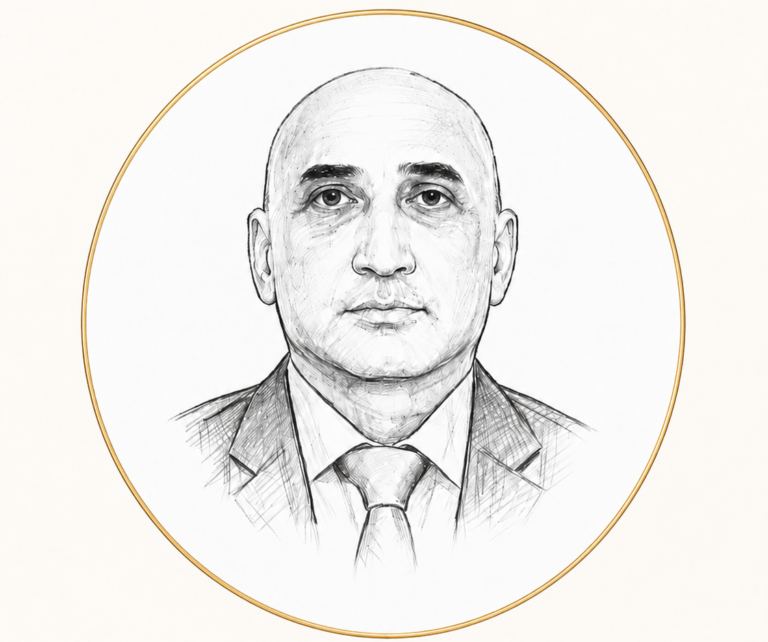
Ivan Račan: Azerbaijan Is Testing How Much Legal Nihilism Europe Is Willing to Tolerate
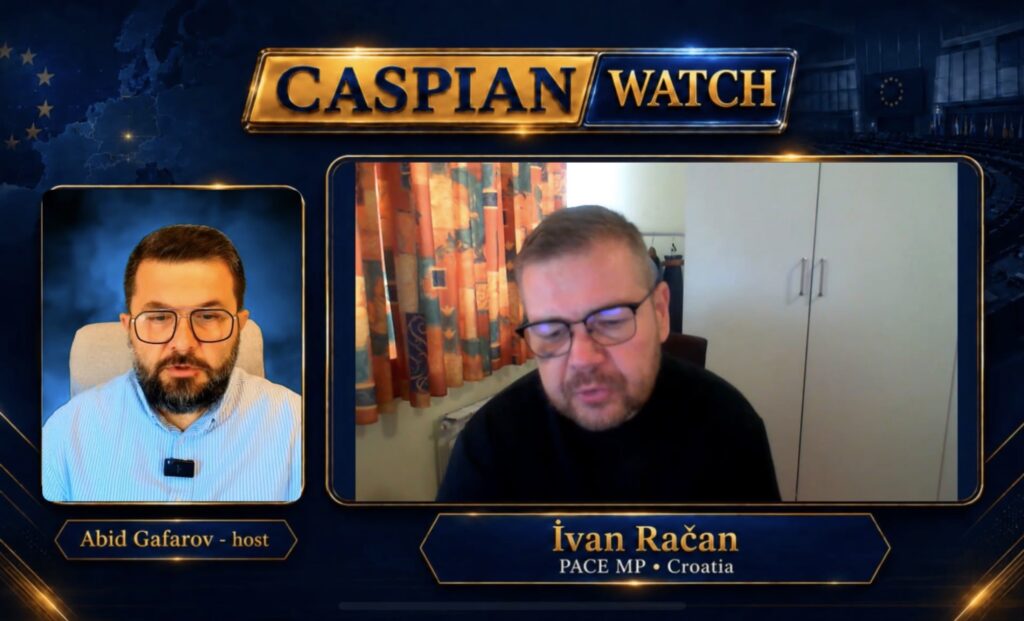
PACE member Ivan Račan speaks to Caspian Watch about the Council of Europe’s policy towards Azerbaijan, the conflict between democratic values and political pragmatism, political prisoners, media freedom, the non-implementation of European Court judgments, targeted accountability measures, and the Council of Europe’s unused legal mechanisms.
Relations between Azerbaijan and the Council of Europe have increasingly become one of the most serious tests of the organisation’s ability to uphold the principles on which it was founded.
On one side stand the fundamental values of human rights, democracy, and the rule of law. On the other are energy security, geopolitical interests, commercial considerations, and political pragmatism.
In this written interview with Caspian Watch, Ivan Račan, a Croatian member of the Parliamentary Assembly of the Council of Europe, examines the nature of this conflict. He argues that independent media and legitimate political competition in Azerbaijan are being systematically restricted, while journalists, human rights defenders, and political opponents are increasingly subjected to criminal prosecution.
According to Račan, Azerbaijan’s refusal to implement binding judgments of the European Court of Human Rights is no longer merely a dispute between Baku and Strasbourg. It represents a challenge to the legal architecture of the Council of Europe as a whole.
Račan also maintains that the Council of Europe already possesses sufficient legal instruments to respond. The problem, he says, is not the absence of legal mechanisms, but the lack of political will among member states to use them.
In this interview, he discusses where the Council of Europe’s red line should be drawn, why the legal mechanisms contained in Articles 52 and 46 of the European Convention on Human Rights and Article 8 of the Statute of the Council of Europe have not been used in a coordinated manner, the case for targeted accountability measures, Azerbaijan’s future within the organisation, and his messages to both the Azerbaijani authorities and the people of Azerbaijan.
1. Values or Pragmatism?
Mr Račan, during the PACE debate on “Silencing Critical Voices in Azerbaijan”, you said that the Council of Europe is neither a military alliance, nor a trade bloc, nor an informal organisation, but an institution based on rules and values—and that these values must not become victims of a “pragmatic approach”. In practical terms, how should the Assembly apply this principle in its relations with Azerbaijan? What specific red line must the Council of Europe refuse to cross?
The Council of Europe rests on three fundamental pillars: the protection of human rights, the promotion of democracy, and the safeguarding of the rule of law.
The message I wanted to convey during the debate was that these foundational principles cannot be set aside or ignored in the name of some supposedly greater interest.
Like any other state wishing to belong to the Council of Europe, Azerbaijan must be judged according to the extent to which it respects these three pillars.
That is the only clear line the Council of Europe must draw.
2. Are Europe’s Democratic Values Under Threat?
Do you believe that Europe’s democratic values have been compromised in the name of commercial and geopolitical interests—Azerbaijani oil and gas, trade, investment, lobbying, “caviar diplomacy”, and perhaps now “gas diplomacy”? Has Europe allowed a dictatorship it considers economically useful to relegate human rights and human dignity to a secondary position?
Europe’s democratic values are indeed being called into question, but Azerbaijan is not the sole reason.
It was easy to champion democracy loudly when it was regarded as the most successful political system in the world. The world has now changed. The rise of China and other powers demonstrates that human rights and democracy, as understood according to European standards, are not necessarily prerequisites for economic success.
This broader geopolitical transformation poses a greater challenge to Europe’s democratic values as a whole than developments related to Azerbaijan alone.
In Azerbaijan’s case, however, the central problem was corruption—one of the most ordinary flaws of human nature: personal enrichment in exchange for turning a blind eye to blatant illegality.
It may have taken far too long for all of this to be exposed and for an adequate response to follow. But ultimately, the necessary steps were taken.
3. Is the Report Strong Enough to Produce Real Results?
The report is highly critical. However, it also notes that the rapporteurs were unable to conduct a fact-finding visit to Azerbaijan and that the cases included in the document represent only some of the most serious examples. In your view, does the report adequately address the entire machinery of repression, including the courts, prosecution service, police, security agencies, prison system, financial controls, and political responsibility? Or does PACE need a deeper and more consistent follow-up process capable of producing enforceable consequences?
The report was the best document that could have been produced under the circumstances of the confrontation that has developed between Azerbaijan and the Council of Europe.
It is clear that the Azerbaijani government is currently failing to respect the basic obligations arising from its membership, particularly freedom of expression and the rule of law.
The report correctly identifies the nature of the machinery of repression and demonstrates how restrictive legislation and criminal prosecutions are systematically used to suffocate independent journalism and civic space.
However, because the rapporteurs were denied permission to conduct a fact-finding visit, the document is inevitably a broad overview rather than a microscopic investigation.
Documenting violations is the first step. Documentation alone, however, does not produce results.
A deeper and more consistent follow-up process is therefore essential.
4. Is Legitimate Political Competition Being Gradually Eliminated?
Azerbaijan’s new Law on Political Parties was criticised by the Venice Commission and the OSCE Office for Democratic Institutions and Human Rights because it made party registration significantly more difficult, increased minimum membership requirements, forced parties to re-register, prohibited unregistered political activity, and granted the Ministry of Justice excessive control over party structures and membership lists.
The subsequent arrest of Ali Karimli, chairman of the Azerbaijan Popular Front Party, and other senior party figures, including Mammad Ibrahim, raised even greater concern.
Do you view these as separate criminal cases, or as part of a gradual process in which legitimate political competition in Azerbaijan is first restricted through legislation, then through administrative pressure, and finally through criminal prosecution?
In a process of authoritarian consolidation, coincidences are extremely rare.
I interpret this as a deliberately constructed chain of events.
First, the rules of the game are changed through restrictive legislation such as the Law on Political Parties, adopted without taking the Venice Commission’s recommendations into account.
This makes it almost impossible for the opposition to operate legally.
Those who nevertheless succeed in organising then face the administrative machinery of the state, which is used to narrow the space available for their activities.
Finally, the criminal justice system is deployed to remove the leadership.
The arrest of figures such as Ali Karimli is not an isolated criminal case.
The cumulative effect of these measures is clearly designed to silence genuine political opposition and close the remaining space for legitimate political competition in Azerbaijan.
5. When Human Rights Defenders Become Prisoners
The case of Rufat Safarov is particularly symbolic. He is a human rights defender who received the US State Department’s 2024 Human Rights Defender Award, but was later sentenced to eight years in prison on charges that international human rights organisations described as fabricated or politically motivated.
Namizad Safarov, a lawyer and human rights defender who spent years defending people imprisoned on allegedly fabricated charges, has also been arrested on fraud allegations.
When those who defend victims of injustice are themselves imprisoned on similar charges, is it still possible to speak of the rule of law in Azerbaijan? If lawyers, human rights defenders, and victims are all portrayed as criminals, what is an ordinary citizen supposed to believe, and what lawful political or legal means of resistance remain available?
The rule of law requires an independent judiciary and lawyers who are able to defend the accused without fear of retaliation.
When human rights defenders and lawyers themselves become targets, the system destroys the very safeguards that are supposed to protect it from within.
Criminal law is then misused to punish and silence those who stand up in defence of others.
Can one speak of the rule of law in such circumstances? No.
The state sends an ordinary citizen a very cold and pragmatic message: do not speak out, because even those who are supposed to defend you cannot defend themselves.
It is a situation in which the shield itself becomes the target, leaving the citizen defenceless.
6. European Court Judgments and Legal Nihilism
For many years, Azerbaijan has failed to fully implement a number of judgments of the European Court of Human Rights.
In April 2025, President Ilham Aliyev publicly stated at ADA University that, because the Azerbaijani delegation had been deprived of voting rights in PACE and had not participated in the election of judges, the Court’s judgments were no longer valid for Azerbaijan.
Yet under Article 46 of the European Convention on Human Rights, the implementation of final judgments is not a matter of political convenience, but a binding legal obligation.
Why, in your view, is official Baku refusing to implement the Court’s judgments? Is this merely a political dispute with Strasbourg, or has Azerbaijan’s domestic legal nihilism now crossed its borders and become an open challenge to the entire Council of Europe system?
Political rhetoric must be distinguished from legal obligation.
The argument that the Court’s judgments are invalid because the Azerbaijani delegation currently lacks voting rights in PACE is legally meaningless.
Under Article 46 of the Convention, Azerbaijan has an unconditional obligation to implement the judgments of the European Court of Human Rights.
The Assembly has firmly and formally rejected this reasoning.
This is not simply a bilateral dispute with Strasbourg. It is a calculated political manoeuvre.
Azerbaijan is testing the limits to see how much legal nihilism the international community is willing to tolerate.
If a member state can decide which binding judgments it will implement and which it will disregard, depending on its current political mood, this constitutes a fundamental challenge to the entire legal architecture of the Council of Europe.
7. Should the 52 → 46 → 8 Sequence Become a Coordinated Strategy?
Many Azerbaijanis have drawn attention to a possible sequence of escalation.
Article 52 of the European Convention on Human Rights authorises the Secretary General to request an explanation of how domestic law ensures the effective implementation of the Convention. Article 46 makes the implementation of European Court judgments legally binding and allows the Committee of Ministers to supervise execution and initiate infringement proceedings.
Article 8 of the Statute of the Council of Europe allows the Committee of Ministers, in cases of serious violations of the organisation’s principles, to suspend a member state’s rights of representation and ultimately begin the process of terminating its membership.
PACE can document violations, issue recommendations, and exert political pressure, but the Secretary General and the Committee of Ministers also possess their own powers. Why has the Council of Europe not applied these mechanisms to Azerbaijan in a more coordinated and progressively escalating manner?
This brings us back to the conflict between values and pragmatism that we discussed at the beginning of the interview.
Why has there been no coordinated escalation?
Because the Council of Europe is made up of different bodies that face different forms of pressure.
The Assembly consists of parliamentarians. We document violations and exert pressure in defence of the organisation’s values.
That is precisely why the adopted resolution explicitly calls on the Secretary General to invoke Article 52 and request an explanation.
The Committee of Ministers, however, consists of government representatives.
Governments take geopolitical interests, energy security, and bilateral trade into account.
Sufficiently strong political will must emerge to overcome this inertia. Unfortunately, such political will has so far been lacking.
The legal instruments—Articles 52, 46, and 8—are fully operational.
The failure to apply them in a coordinated manner does not reflect a lack of legal possibilities. It reflects a lack of political courage among member states.
8. Why Are Targeted Accountability Measures Not Used More Seriously?
Broad sanctions may harm ordinary people already living under authoritarian rule and difficult economic conditions.
Would you instead support targeted measures such as visa bans, asset freezes, accountability for officials involved in torture, politically motivated prosecutions, attacks on journalists, and transnational repression, as well as restrictions on their participation in Council of Europe bodies?
Should such measures apply only to direct perpetrators, or also to those who issue orders, protect perpetrators, and benefit from the system?
Broad sanctions are usually a blunt instrument that punishes the general population, while the ruling elite finds ways to shield itself from their effects.
Targeted measures are therefore the most logical and effective option.
When an authoritarian system rests on corruption, patronage, and personal enrichment, the assets, banking privileges, and freedom of movement of those who sustain that system should be targeted.
Holding only low-level perpetrators—such as prison guards or lower-court judges—accountable is not enough.
The entire chain of command must be addressed.
This includes those who order politically motivated prosecutions, those who protect the perpetrators, and those who benefit financially from the system.
Individuals who oppress people in their own country while enjoying the comforts of European democracies should not be allowed to continue this hypocrisy.
9. Can Azerbaijan Remain a Credible Member of the Council of Europe?
If a country is reported to have hundreds of political prisoners, no independent media outlet is able to operate freely inside the country, European Court judgments remain unimplemented, and the authorities refuse normal cooperation with the Assembly, can that country still be regarded as a credible member of the Council of Europe?
What should the minimum conditions be for restoring normal relations or full participation: the release of political prisoners, implementation of Court judgments, submission of a new list of candidates for the post of Azerbaijani judge at the Court, access for monitoring bodies, reform of legislation governing the media, NGOs, and political parties, or should further conditions also be imposed?
At present, Azerbaijan cannot be regarded as a credible member of the Council of Europe.
A state cannot systematically silence all independent media operating within its borders, hold hundreds of political prisoners, disregard binding judgments of the European Court, and at the same time present itself as a reliable member that complies with its obligations.
There is no need to invent new rules for restoring normal relations.
Azerbaijan must simply comply with the obligations it voluntarily accepted.
The minimum conditions have been clearly identified by the Assembly: the immediate release of political prisoners, an end to threats and pressure against journalists, and the full implementation of outstanding judgments of the European Court of Human Rights.
In addition, Azerbaijan must resume cooperation with the system by submitting a list of candidates for the position of judge at the Court.
These are not arbitrary demands. They are the most basic conditions of membership.
10. Two Messages: One to the Authorities and One to the Azerbaijani People
Finally, I would like to ask you for two separate messages.
First, what is your concrete message to the Azerbaijani authorities concerning political prisoners, imprisoned journalists, allegations of torture, the implementation of European Court judgments, and Azerbaijan’s place in the Council of Europe?
Second, what would you like to say to the citizens of Azerbaijan, including political prisoners, imprisoned journalists, victims of torture, activists, exiles, and families living under pressure?
What personal and practical commitment are you prepared to make to ensure that this issue is not forgotten after the next resolution?
My message to the Azerbaijani authorities is this: the Council of Europe is not an informal club or an “à la carte” menu from which you may choose which human rights obligations you wish to respect.
The obligations you voluntarily accepted remain in force.
You will not be able to evade responsibility simply by waiting for international attention to fade over time.
To the citizens of Azerbaijan, imprisoned journalists, and families living under pressure, I can only say this with humility: you are not invisible.
The Assembly has formally decided to keep the protection of journalists and activists in Azerbaijan actively on its agenda.
We are documenting the violations.
My personal commitment as a parliamentarian is to ensure that this issue does not become old news and fade into obscurity.
I will use my mandate in the Assembly to demand institutional accountability and to ensure that these cases remain a central obstacle to any return to “business as usual”.