Azerbaijan Expands Powers to Block Websites as Online Censorship Intensifies
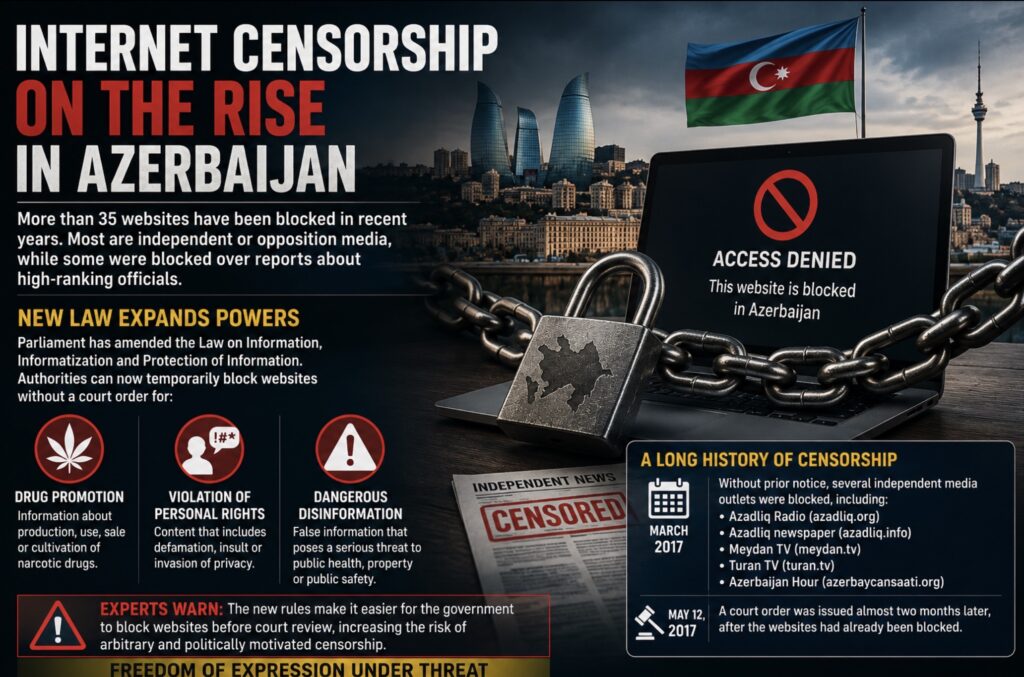
The Azerbaijani parliament has approved legislative amendments that significantly expand the government’s authority to temporarily block internet resources before obtaining a court order, raising fresh concerns over freedom of expression and digital rights.
The amendments to the Law on Information, Informatization and Protection of Information were adopted on July 10. Under the new provisions, the relevant executive authority will be able to temporarily restrict access to websites in a wider range of cases pending judicial review.
The new grounds include:
- content promoting the production, use, sale or cultivation of narcotic drugs;
- publications considered to contain defamation, insults, or violations of personal privacy;
- false information deemed to pose a serious threat to public health, property or public safety.
Previously, authorities could impose temporary restrictions only in urgent situations where online content posed an immediate threat to the legally protected interests of the state or society, or created a real danger to human life and health. The latest amendments considerably broaden those powers.
Independent experts acknowledge that combating cybercrime and harmful online content is a legitimate objective. However, they warn that the expanded legal framework could make it significantly easier for authorities to block websites without prior judicial oversight, particularly by relying on broadly defined concepts such as “defamation,” “insult,” or “dangerous disinformation.”
The amendments come amid growing concerns over internet freedom in Azerbaijan.
According to media and digital rights observers, more than 35 websites have been blocked in Azerbaijan in recent years. Many of the affected outlets are independent or opposition-oriented media organizations critical of the government. Other websites have reportedly been blocked after publishing investigative reports concerning senior government officials.
Website blocking has been practiced in Azerbaijan since March 2017, when authorities blocked access to several independent news outlets—including Azadliq Radio, Azadliq newspaper, Meydan TV, Turan TV, and the Azerbaijan Hour television project’s website—without prior warning.
A formal court order authorizing those restrictions was issued only on May 12, 2017, nearly two months after access had already been blocked. Authorities accused the outlets of publishing material that threatened national security and state interests, while the media organizations rejected the allegations as unfounded and politically motivated.
Since then, the list of blocked websites has continued to grow. Press freedom organizations have repeatedly criticized the Azerbaijani authorities for using website blocking as a tool to restrict access to independent journalism and dissenting voices. Human rights advocates argue that the latest legislative amendments could further expand state censorship by allowing authorities to suspend access to online platforms before courts have an opportunity to review the legality of such decisions.