PACE MP Ivan Račan: Azerbaijan Is Testing How Much “Legal Nihilism” Europe Will Tolerate
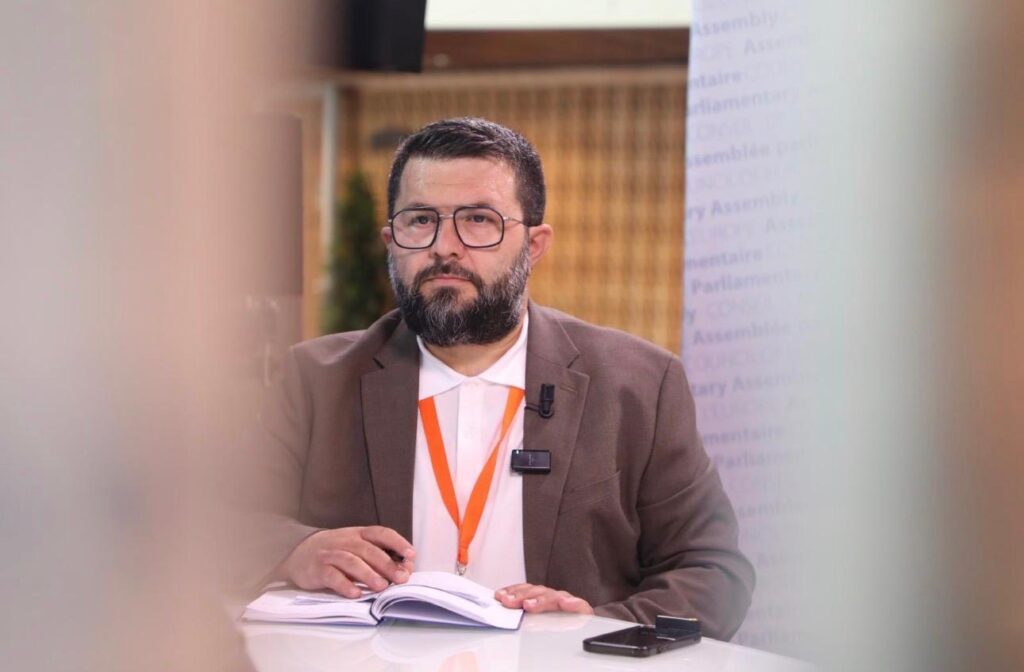
PACE member Ivan Račan has called for coordinated legal and political pressure on Azerbaijan, targeted accountability measures against officials involved in political repression, and the immediate release of imprisoned journalists, human rights defenders and civil society activists. In an interview with Azerbaijani journalist Abid Gafarov, Račan warned that the Council of Europe must move beyond resolutions and use the legal mechanisms at its disposal if Baku continues to disregard its obligations.
STRASBOURG — The Council of Europe must ensure that its recent resolution on Azerbaijan is followed by concrete action rather than becoming another political declaration without consequences, Parliamentary Assembly of the Council of Europe (PACE) member Ivan Račan has said.
In an interview with Azerbaijani journalist Abid Gafarov, Račan addressed the crackdown on independent media and civil society in Azerbaijan, political prisoners, Baku’s deteriorating relations with PACE, targeted accountability measures, the protection of Azerbaijani exiles in Europe, energy interests, and an international petition calling for the release of 40 imprisoned journalists and bloggers.
Račan said the recent PACE resolution was an important starting point because it formally documented the scale of repression in Azerbaijan, including the detention of journalists and the elimination of independent media inside the country.
“Resolution is an essential first step because it clearly documents the facts including the reality that not a single independent media outlet continues to operate inside Azerbaijan and that 36 journalists are currently detained,” he said.
But he stressed that documenting violations was not enough.
“Documentation alone does not produce consequences.”
According to Račan, the next stage should involve coordinated action across the institutions of the Council of Europe.
“The next practical step is coordinated institutional follow-up: we must press the Secretary General to invoke Article 52 of the Convention to demand legal explanations, and push the Committee of Ministers to treat the non-implementation of European Court judgments as a hard line.”
“We cannot sit in a waiting room while repression continues”
Relations between Azerbaijan and PACE have deteriorated sharply, with political dialogue and cooperation between Baku and the Assembly severely disrupted.
Asked whether the Council of Europe should continue waiting for dialogue to resume or move towards stronger legal and political pressure, Račan said the organisation could not remain passive.
“The Assembly has formally called on the Milli Mejlis to resume dialogue, but we cannot sit in a waiting room while repression continues.”
He argued that a member state’s refusal to cooperate does not relieve it of its obligations under the European Convention on Human Rights.
“When a member state suspends cooperation and avoids dialogue, the Council of Europe must move from waiting to active legal and political pressure.”
Račan said this should include intensified work by PACE’s Monitoring Committee and stronger insistence on Azerbaijan’s obligations under Article 46 of the European Convention on Human Rights, which requires states to comply with final judgments of the European Court of Human Rights.
Release of political prisoners should be a baseline condition
Račan also took a firm position on whether the release of political prisoners should be linked to the restoration of normal relations between Azerbaijan and European institutions.
“Yes, absolutely,” he said.
“With over 300 reported political prisoners in the country, the immediate release of imprisoned journalists, human rights defenders, and civil society activists along with dropping all fabricated charges is a baseline requirement for restoring normal relations.”
He warned, however, that releases alone would not be sufficient if the legal and institutional structures that enable persecution remained unchanged.
To prevent released prisoners from being targeted again, he said Azerbaijan must undertake structural legal reforms, beginning with the implementation of recommendations made by the Venice Commission concerning legislation governing the media, NGOs and political parties.
Targeted measures should reach the “entire chain of command”
Asked whether Europe should establish a specific list of individuals responsible for politically motivated arrests, torture, fabricated criminal cases and persecution of journalists, Račan backed targeted accountability measures rather than broad sanctions.
“General sanctions are blunt instruments that hurt ordinary citizens while the ruling elite insulate themselves,” he said.
“Targeted measures are the most logical and effective tool.”
Račan said accountability should not stop with officials who directly carry out abuses.
“A specific list should be drawn up, and it should not be limited to low-level perpetrators like prison staff or judges.”
Instead, he argued, responsibility should extend upwards through the political and administrative system.
“It must target the entire chain of command, particularly senior officials who order politically motivated prosecutions, those who protect the perpetrators, and those who benefit financially from the system.”
Europe must protect Azerbaijani journalists and activists in exile
The interview also addressed concerns over transnational repression against Azerbaijani journalists, activists and political exiles living in Europe.
Račan said European states should take concrete measures to protect people forced to leave Azerbaijan because of their journalism, political activity or human rights work.
“European governments must facilitate visas and give careful consideration to asylum requests from Azerbaijani journalists, opposition politicians, and rights defenders who are forced to leave.”
He said protection must also extend to extradition and deportation procedures.
“Equally critical, member states should refuse extradition requests based on politically motivated charges and halt any deportations where individuals face a genuine risk of political persecution or transnational repression.”
Human rights cannot be traded for energy interests
Asked whether European governments had been reluctant to confront Baku more forcefully because of energy security and commercial interests, Račan acknowledged a tension between European values and geopolitical pragmatism.
“We have to be realistic about the tension between values and pragmatism, energy security and bilateral trade create political inertia among member state governments,” he said.
But he insisted that such interests could not override the Council of Europe’s fundamental principles.
“The Council of Europe is a values-based organization, and its core pillars of human rights, democracy, and the rule of law cannot be traded away for commercial pragmatism.”
Račan called on national parliaments and PACE to exercise greater transparency and oversight over bilateral energy arrangements to ensure economic interests do not weaken Europe’s response to human rights violations.
A commitment for the coming months
Gafarov asked Račan what Azerbaijani society should expect from him personally over the next three to six months and what measurable action he would pursue.
“My personal commitment as a parliamentarian is to ensure this situation does not fade into old news,” Račan said.
He pledged to use his mandate in the Assembly to push for institutional accountability, support follow-up initiatives concerning targeted accountability measures and, where possible, raise individual cases in parliamentary debate.
For Azerbaijanis seeking a tangible measure of whether European pressure is continuing, Račan said the cases of imprisoned journalists and activists must remain central to relations with Baku.
“Azerbaijani society can measure the result of our work by seeing that the protection of imprisoned journalists and activists remains an active, central obstacle to any ‘business as usual’ approach in Strasbourg.”
Baku’s “piece of paper” response
One of the strongest exchanges in the interview concerned the Azerbaijani authorities’ dismissal of PACE’s 24 June resolution as essentially a “piece of paper.”
Gafarov asked why Baku had reacted so strongly to the resolution if it truly regarded the document as insignificant.
“If the resolution was truly just a piece of paper Baku would not react with such intense defensiveness or sever its cooperation with the Assembly,” Račan replied.
He argued that dismissing the resolution did not answer the substance of the allegations documented by PACE.
“Dismissing it as paper is an admission that the authorities cannot answer the facts set out in the document—such as the complete suppression of independent media—either legally or politically.”
Asked whether repeated resolutions without consequences could ultimately convince Baku that the Council of Europe lacked the power to influence events, Račan warned against institutional inertia.
“This is precisely why we must avoid inertia.”
“If the Council of Europe responds only with words and fails to use its legal instruments in a coordinated way, Baku will test the boundaries to see how much legal nihilism will be tolerated.”
He said responsibility ultimately rests with Council of Europe member states to demonstrate the political will necessary to enforce the organisation’s rules.
“It is up to member state governments to show political courage so that the organization’s rules are enforced.”
Petition for 40 imprisoned journalists and bloggers
Račan has also signed the international petition calling for the release of 40 journalists and bloggers imprisoned in Azerbaijan.
Asked whether petitions can generate meaningful political pressure rather than serving solely as expressions of solidarity, he said attaching names and individual cases to advocacy efforts was particularly important.
“Petitions like this are much more than moral solidarity; they put specific names and individual cases in front of European lawmakers, preventing imprisoned journalists from being treated as anonymous statistics.”
According to Račan, signing a petition should be followed by efforts to introduce individual cases into parliamentary debates, monitoring procedures and bilateral discussions with the Azerbaijani authorities.
“The concrete step following a signature is to bring those specific cases directly into parliamentary debates, monitoring procedures, and bilateral discussions with Azerbaijani authorities.”
Asked directly whether he would help promote the petition among other members of PACE, Račan responded:
“Yes I will gladly share and support this petition among my colleagues in PACE.”
“Your journalism is no longer treated as a crime”
At the end of the interview, Gafarov asked Račan to address Azerbaijani journalists currently behind bars in a single sentence.
Račan replied:
“We will continue to use parliamentary tools we have until your freedom is restored and your journalism is no longer treated as a crime.”
The statement summed up the central message of the interview: resolutions documenting repression in Azerbaijan must now be translated into sustained political, legal and institutional action.
For Račan, the credibility of the Council of Europe will increasingly depend not simply on whether it condemns violations, but on whether its institutions and member states are prepared to enforce the commitments Azerbaijan accepted as a member of the organisation.
Interview conducted by Abid Gafarov.