Interview with Frank Schwabe
Introduction and Dedication
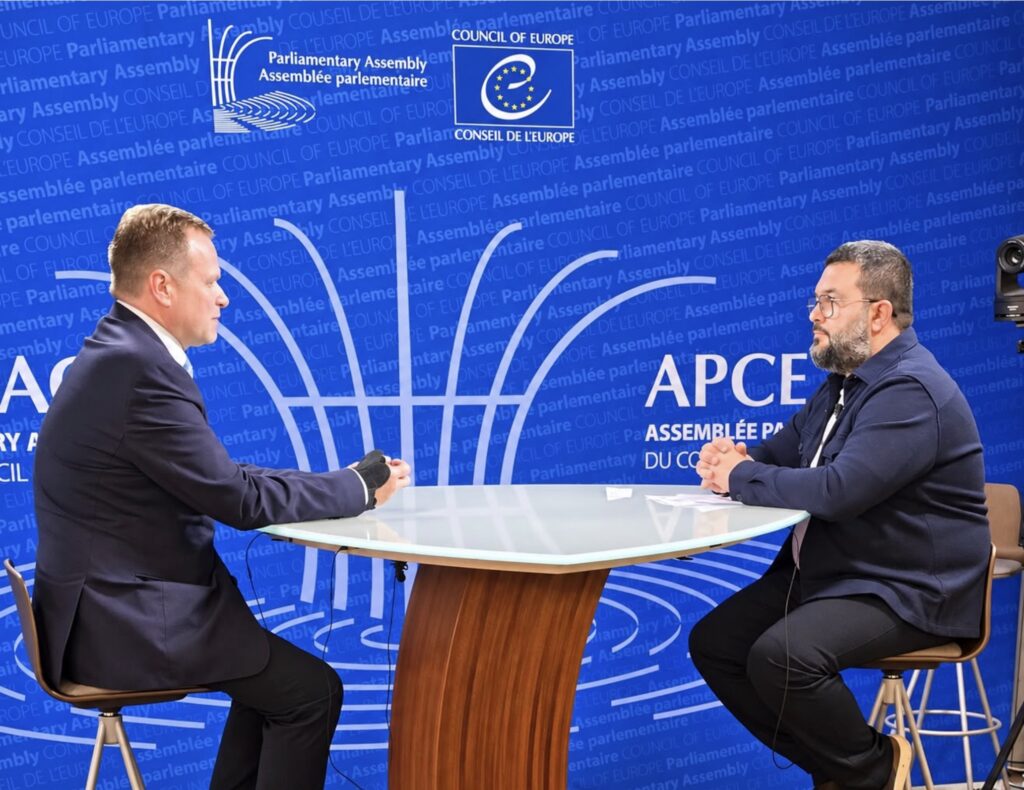
Abid Gafarov: Hello, ladies and gentlemen. I am Abid Gafarov, founder of Caspian Watch and a journalist from Azerbaijan. Our guest today is Mr Frank Schwabe, a member of the German Parliament. We will discuss the human rights situation and crisis in Azerbaijan. Mr Schwabe, thank you for your time and for agreeing to this interview.
Frank Schwabe: Thank you.
Abid Gafarov: Ladies and gentlemen, I would like to dedicate this interview to the memory of my colleague and friend, journalist Avaz Zeynalli. He was imprisoned twice by Ilham Aliyev’s regime on fabricated charges. During his most recent imprisonment, he was diagnosed with cancer. After a long struggle with the disease, Avaz Zeynalli passed away yesterday, 28 September. May God have mercy on him. May he rest in peace.
Mr Schwabe, thank you. As we can see, democracy allows people to live, while dictatorship takes their lives away. Thank you once again for your time.
PACE Resolution 2663 and Targeted Measures
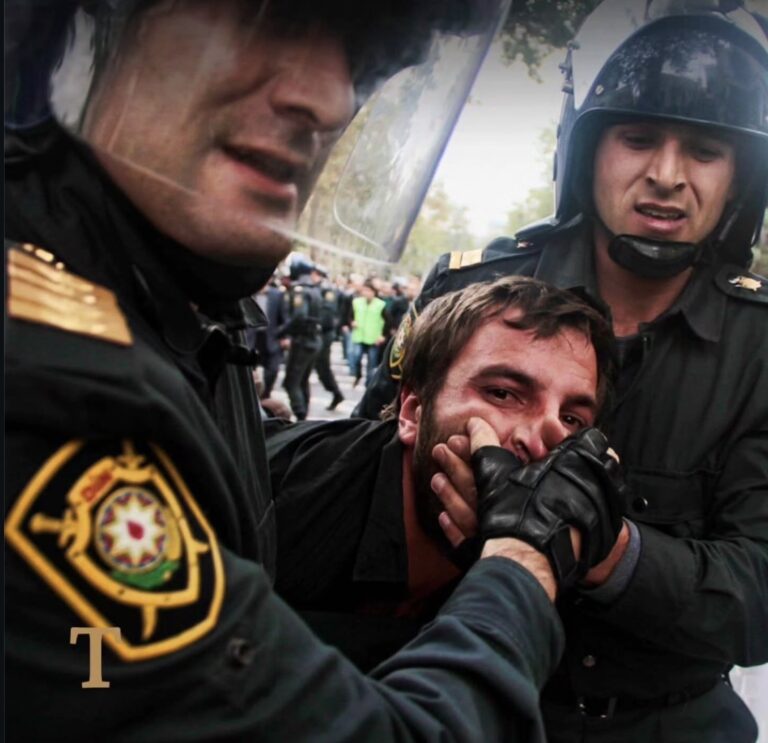
Abid Gafarov: My first question concerns developments following the adoption of PACE Resolution 2663. Since PACE adopted the resolution on 24 June, repression in Azerbaijan has intensified. Nine journalists and civil society representatives detained in the Toplum TV case have received prison sentences totalling 121 years. The detention periods of Ali Karimli, chairman of the Azerbaijan Popular Front Party, and human rights defenders Rufat Safarov and Namizad Safarov have also been extended.
If resolutions and political appeals are not producing results, what stronger measures should PACE recommend to Council of Europe member states? Should targeted measures against responsible officials also be considered?
Frank Schwabe: The issue is not limited to the cases you have mentioned. For me, one of the most important and striking cases is that of Anar Mammadli. He is a recipient of the Parliamentary Assembly of the Council of Europe’s Václav Havel Human Rights Prize. There are several judgments by the European Court of Human Rights in his case, and ultimately, he must be released. What more is there to discuss? What clearer response could we expect from the president of Azerbaijan?
Regarding sanctions, every international institution can act within its own mandate. We are not an organisation that imposes sanctions on individuals. Ultimately, that is a matter for the European Union, which can impose economic sanctions.
What we can do is express a clear position on behalf of the Council of Europe. I am speaking for the majority in the Assembly, rather than for the entire parliamentary dimension of the Council of Europe: we clearly see what is happening in Azerbaijan. That is precisely why the Azerbaijani delegation is not here. As long as this situation continues, that position will not change. Other institutions must also do their part.
Recognition of European Court Judgments
Abid Gafarov: President Ilham Aliyev says that Azerbaijan does not recognise the judgments of the European Court of Human Rights because the Azerbaijani delegation did not participate in the election of the Court’s judge. Does this argument have any legal basis under the European Convention on Human Rights, or is it a political attempt to evade Azerbaijan’s international obligations?
Frank Schwabe: I am certain that it has no legal basis. I think that is also the answer you expected.
We need to look at the history of what happened. There are many reasons why the Azerbaijani delegation is not here. One of those reasons is the failure to implement the Court’s judgments. The authorities do not want to implement them, or they intend to implement only the judgments they like. But there is no choice to be made here: whatever the Court rules must be implemented. Everything else is an excuse.
It is clear what he wants. He wants to be a member of this organisation, even though he constantly complains about it and blames it. I am certain that membership is important to him. But he wants to enjoy the benefits of membership without fulfilling its obligations or following the organisation’s rules. That is impossible.
The Azerbaijani Delegation’s Return to PACE
Abid Gafarov: In your view, what needs to happen for the Azerbaijani delegation to return to PACE? What steps must Ilham Aliyev take?
Frank Schwabe: There is a report on this, and it clearly sets out what we require from Azerbaijan.
Some of these matters are standard procedures that every country must follow. For example, rapporteurs must be granted unrestricted access to all parts of the country. This was possible even in Russia. It is also possible in Türkiye, although it is not always easy. Azerbaijan is the only country where it is impossible.
When we want to send an election observation mission, the country must invite us. All countries do this. Even Kazakhstan, where I know how difficult the situation is, invites us and wants the mission to come. Azerbaijan, however, ultimately says it does not want this.
In addition, parliamentarians such as myself are banned from entering the country. These are standard procedures, and Azerbaijan must comply with them again.
But these steps alone are not enough. There must be a clear indication that Mr Aliyev wants to move away from an increasingly authoritarian course. Even if the change is modest, we need to see steps that give us hope that we can continue our journey together.
Political prisoners must be released, and a process of democratisation must begin. At present, we do not see a single signal in that direction. Unfortunately, that is the reality.
Implementation of Court Judgments and Possible Procedures
Abid Gafarov: Regarding the implementation of European Court judgments, Article 46 of the Convention and PACE Resolution 2663 require compliance with the Court’s final judgments. If Azerbaijan refuses to implement these judgments and considers leaving the Council of Europe, what concrete legal and political steps should PACE and the Council of Europe take?
Frank Schwabe: We have already taken many decisions. Probably the most visible one is that the Azerbaijani delegation is not here.
Of course, a complementary joint procedure could be initiated, but that decision must be taken together with the Committee of Ministers. If the Committee of Ministers and national governments believe action is necessary, it is up to them to propose such a procedure.
A procedure under Article 46, paragraph 4, of the Convention has previously been used against Azerbaijan in the case of Ilgar Mammadov. Such a procedure could be initiated again.
But in a world where several countries are moving in an authoritarian direction, this is not an easy matter. There is also the question of how feasible it is to deal with a new procedure every day.
Looking at global rankings, although some countries are moving in the wrong direction, we still see grounds for hope in most Council of Europe member states. Azerbaijan, however, is in an exceptionally serious situation. I see none of the elements we would expect from a country that respects democracy, the rule of law and human rights.
Prospects for Political Change in Azerbaijan
Abid Gafarov: Considering that Ilham Aliyev’s regime has dismantled political and civic institutions, it is impossible to establish and operate a political party, or even to create independent media. With these institutions dismantled or destroyed, how can change happen in Azerbaijan? What possible scenarios do you see?
Frank Schwabe: I cannot identify a specific scenario.
International organisations are important. They can help preserve peace between countries and help bring about peace. But we have no weapons. We cannot take weapons away from the parties to a conflict or enforce peace through force. Similarly, we cannot establish and impose democracy in a country from outside.
If a country wants advice and support to move in the right direction, we are ready to provide it. But decisions and developments must come from within the country. Beyond what I have already said, I cannot determine exactly what should be done inside Azerbaijan.
If we see even a small sign of hope that things are moving in the right direction, we are ready to support anyone working towards that goal. This does not mean that everything in the country must immediately become perfect. But nobody should try to deceive us: you cannot seek membership of an organisation while opposing all its rules.
I have often used the following example when speaking about Azerbaijan: it is like two teams playing football. One team wants to handle the ball, but still demands to play in the same league as everyone else. That is impossible. Such behaviour harms your own country, other countries and the entire system.
We have seen this in the past. When they could not find a way out, they tried to bribe certain politicians, including, unfortunately, people from Germany. They organised smear campaigns against others who spoke openly about the situation. I have experienced this myself.
If they think they can break me through such methods, they are mistaken. On the contrary, I will become more determined and increase the pressure on this issue. I know what I am doing, and I know what Mr Aliyev and those around him are doing.
Energy Cooperation and Human Rights
Abid Gafarov: My next question concerns the relationship between energy cooperation and human rights. Paragraph 10 of the European Parliament’s 2024 resolution calls on the European Union to end its dependence on Azerbaijani gas and suspend the 2022 energy memorandum.
As a PACE member and a national parliamentarian, do you believe that energy cooperation with Azerbaijan should depend on its compliance with its human rights obligations to the Council of Europe? What concrete steps should national governments, particularly those of EU member states, take to advance this proposal?
Frank Schwabe: This is always a very difficult question. I know that I sometimes do not give the answer that human rights defenders and others would like to hear, because I also take global realities into account.
Most countries have authoritarian regimes, are outright dictatorships, or are moving in an authoritarian direction. Unfortunately, such countries constitute a majority in the world. If we stopped trading with all of them, the situation would become very difficult. China is the biggest, or perhaps the worst, example. We can also look at what is happening in Arab countries.
For that reason, I am cautious about lecturing the European Union and national governments on what they should do. Of course, I do not approve of the current situation. There is also no need to stand in the sunshine posing for flattering photographs. But I am not someone who demands the immediate and complete suspension of economic cooperation with countries other than Russia.
In Russia’s case, economic pressure has a different purpose: the country must end the war, understand the economic consequences of sanctions, and, we hope, be encouraged by those consequences to stop its war against a neighbouring state.
When it comes to other countries, I am more cautious about using this instrument.
US Policy and the Global Rise of Authoritarianism
Abid Gafarov: Speaking of the global rise of authoritarianism, Baku’s rhetoric towards European institutions has become harsher since Donald Trump returned to the presidency. Do you think the current US administration’s greater emphasis on security and economic interests, rather than human rights, has contributed to this change?
Frank Schwabe: Without question, this US administration is not a good example for any country. The president does not show sufficient respect for human rights, the rule of law or democratic rules. That is the reality.
But nothing lasts forever. One day, Mr Trump will no longer be in office.
Whatever we may think about the United States, I am confident in the country’s resilience. Its system of checks and balances is entirely different from that of Azerbaijan and several other countries around the world.
The behaviour of American society may sometimes seem unusual, but even Donald Trump will not be able to destroy the country. The United States will regain its previous standing and remain influential around the world.
The next administration may take an entirely different approach to the South Caucasus and Azerbaijan. So do not assume that you will always have enough dictator friends to support you in the future. I recognise the current reality, but I remain optimistic about the future.
A Message to Political Prisoners and Their Families
Abid Gafarov: Our time is coming to an end, but I would like to ask one final question.
We will soon present our next report on political prisoners. We expect the list to include approximately 340 people. Among them are Alasgar Mammadli, who has a serious health problem affecting his throat, as well as Aytaj Tapdig, Farid Ismayilov and others.
What is your message to those currently held in the Aliyev government’s prisons because of their struggle for democracy, and to their families?
Frank Schwabe: I can say that we see you and are following your situation.
We have good rapporteurs. The new rapporteur for this report is also a very reliable and impartial person who takes a clear position on the situation.
We cannot go into prisons and take people out. That is impossible. But we can offer hope. Ultimately, some people will be released from prison, and others will be held accountable for what they have done.
Abid Gafarov: Mr Schwabe, thank you very much for your time and patience.
Ladies and gentlemen, our guest for this special Caspian Watch interview was Frank Schwabe, a member of the German Parliament. Thank you.
Frank Schwabe: Thank you.