From Trials in Absentia to NO-ID Journalism: An Anonymous Journalism Model Against Transnational Repression
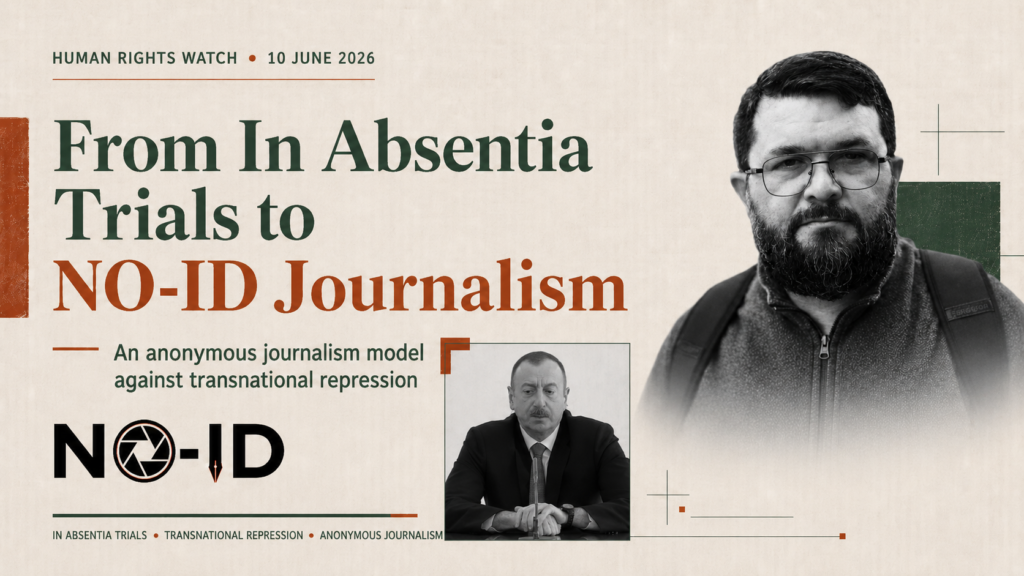
The statement published by Human Rights Watch on June 10, 2026, shows that the situation around freedom of expression in Azerbaijan is no longer only a domestic issue. It has turned into a model of repression that goes beyond the country’s borders. According to the organization, legal and political pressure built up in recent years has expanded to target critics living in exile as well. This process has become more systematic through the use of “trials in absentia.”
One of the key points in the statement is that journalists, public activists, and government critics living abroad are being prosecuted because of their social media posts, online speeches, and articles written years ago. This approach is not presented as a set of isolated cases, but as a wider legal trend: activities related to expression are increasingly being pushed into the field of criminal law.
HRW notes that, after recent legal changes, criminal convictions in absentia have started to be used more widely. This means that people living outside the country can be tried without being present in court and can face very heavy prison sentences.
According to the cases examined by the organization, Azerbaijani citizens living in European countries and in the United States have been sentenced to between 6 and 16 years in prison. In these cases, the main evidence includes state-appointed expert opinions, social media posts, and videos.
HRW especially underlines that the right to defense in these proceedings is mostly formal. In trials in absentia, the accused are practically unable to defend themselves, while the role of state-appointed lawyers does not meet the standards of an effective defense.
One of the main concepts in the statement is “transnational repression.” This means the use of legal and political pressure not only inside the country, but also against critics living abroad.
According to HRW, this mechanism works in several parallel ways: court decisions in absentia, extradition requests, the risk of detention during international travel, pressure through family members, legal uncertainty, and a constant sense of danger. As a result, even people who have left the country do not gain full safety and remain potential targets.
Another important point in HRW’s assessment is the nature of the evidence. In many cases, old social media posts, YouTube videos, and political speeches are turned into criminal charges. These materials are often connected to broadly interpreted accusations such as “calls for violence” or “activities against the state.”
The organization states that, under international law, freedom of expression protects not only popular or accepted opinions, but also controversial, critical, and even harsh statements. When there is no real and direct call for violence, the criminalization of political speech cannot be considered compatible with legal standards.
This legal trend also has a direct impact on the media environment inside the country. In recent years, pressure on independent journalists has increased, the ability of newsrooms to operate has been restricted, and arrests have become more frequent. As a result, the space for information is becoming even narrower.
One of the initiatives formed in response to this reality is the “NO-ID Journalism” model. This approach does not change the essence of journalism, but it adapts the way journalism works to new security conditions.
The main principle of the model is that the journalist’s identity should not be more important than the quality and public value of the information they provide. For this reason, authors within the project write under pseudonyms.
The goal of the initiative is not to create signatures, but to make sure journalism continues in a situation where a signature itself can become a source of danger. It serves as an alternative platform especially for independent media representatives who are at risk.
According to the approach of the initiative’s founders, Abid Qafarov and Kamran Nasirli, this model is not about individual recognition. It is designed to protect collective journalism.
The picture described by HRW and the emergence of the “NO-ID Journalism” initiative show two sides of the same reality: one is the expansion of legal and political pressure, and the other is a new form of media adapted to that pressure.
On one side, there are trials in absentia, extradition risks, and mechanisms of transnational pressure. On the other side, a new journalism model is taking shape — one built on anonymity, but focused on keeping information alive.
The main question within this balance remains the same: Does journalism live through names, or through content?
HRW’s warning and new media initiatives point to the same conclusion: even if the flow of information is blocked, alternative forms of it will continue to emerge.
The doors are open to all colleagues who want to join this initiative — with an open name, anonymously, under a pseudonym, with ideas, or with advice — in whatever way possible.
Journalists whose identities need to remain confidential will write under pseudonyms. On the “About Us” section of the Caspian Watch website, they will be presented under those pseudonyms. Instead of using their own profile photos, they will be able to choose and use the photo of any journalist currently in prison. In this way, a message will be sent both to our society and to the dictator: “My colleague’s work lives on!”